Saturday, March 29, 2014

SPEAKER-ELECT TONI ATKINS RECOGNIZES COMMUNITY LEADERS AS WOMEN OF THE YEAR FOR THE 78TH ASSEMBLY DISTRICT


(San Diego) In recognition of Women’s History Month, Majority Leader Toni Atkins today honored nine leaders from throughout her Assembly district for their accomplishments at a Women of the Year Awards ceremony at the State of California building in downtown San Diego.  Hailing from all parts of the extended 78th Assembly District, these women have found success in medicine, law, entrepreneurship, community organizing, and environmental advocacy.

“Women are leaders in every aspect of our society, yet they are not always recognized for their accomplishments” says Atkins. “The women I honor today have made San Diego a better place and are role models for both young men and young women in our community.  I thank them for their service.”


Speaker-elect Toni Atkins honors the Women of the Year for the 78th Assembly District.  From left to right: Hon. Patricia Ann Yim Cowett, Gerri Retman-Opper, Cincy Greatrex, Barbara Bry, Speaker-elect Atkins, Dr. Betty Jones, Linda LeGerrette, Mayda Winter, Patricia McQuater, Nancy Weare

Barbara Bry – La Jolla
Barbara is a serial entrepreneur whose passion is leveling the playing field for women and girls in business, health care and politics.  Currently, she is the chief operating officer of Blackbird Ventures, which invests in and incubates early stage technology companies.  She teaches entrepreneurship at UC San Diego and is the founder of Athena San Diego, the leading organization for women in the San Diego technology and life sciences community.  She was the first editor of the non-profit investigative news site, Voice of San Diego.

Bry is also the founder of Run Women Run, a non-partisan political action committee that identifies, inspires, mentors, trains and supports pro-choice women in San Diego for both elected and appointed offices.

The Hon. Patricia Ann Yim Cowett - Coronado

Judge Cowett is a recently retired judge of the San Diego Superior Court.  She was the first woman of Chinese descent to be appointed to the California bench and as best as records can tell, the first in the nation.  She was a deputy city attorney for the City of San Diego, an attorney for the state Department of Transportation, and in-house litigation counsel for SDG&E before being appointed by Governor Brown to the bench in 1979.

She was the founder of the Pan Asian Lawyers of San Diego and the Asian American Judges of California.  She served on numerous boards and commissions including the Judicial Nominations and Evaluation Commission of the State Bar.  Since retiring in 2008, Judge Cowett has been acting as a private mediator and arbitrator for the American Arbitration Association and ADR Services, Inc.

Ms. Cindy Greatrex – La Jolla
Cindy is employed in the field of biotechnology, providing remote medical care via software and other medical devices, as well as genomics sequencing so that companies can decode and analyze molecular structures.

She serves on several boards in San Diego, and is currently president of the La Jolla Town Council and Independent La Jolla,  a membership based community organization comprised of citizens united by their deep concern for La Jolla’s future.

In greater San Diego, Cindy serves as board member of Access Youth Academy; Adopt-a-Special Kid, a national organization enabling adoptions from foster care, focusing on LGBT and single-parent adoptions; International Orphan Care of San Diego, which assists orphans from Afghanistan to be productive and educated; Hatech, a telecommunication foundation for the deaf; and the San Diego-Jalalabad Sister Cities foundation, which provides medical and education services to Afghan civilians.

Dr. Elizabeth Jones  - Coronado

Dr. Jones specializes in providing international programs promoting good health in infants and children.  She has worked for Scripps Metabolic Clinic and Research Foundation; Scripps Green Hospital; Mercy Hospital; Wellstart International; and has volunteered in Tijuana since 1976, teaching nutrition for patients, families, paraprofessionals and physicians.

Together with Dr. Chong-King, a highly regarded Tijuana pediatric surgeon, she founded the Foundation for the Children of the Californias, a tri-national collaboration between Canada, the U.S. and Mexico.  This pediatric facility has expanded to 25 specialties, providing more than 380,000 consultations; 9,500 surgeries; 280,000 hours of education; 350 volunteer hours and many outreach programs serving impoverished areas.

Linda LeGerrette – Golden Hill, San Diego
Linda is a founding member of the César Chávez Service Clubs, an organization dedicated to teaching our youth to believe in themselves and to know that they can make a difference and where they learn the values of leadership and organizational skills necessary for participation in a democratic society. Because of her hard work, leadership and direction, the Chávez Service Clubs are the fastest growing youth leadership club in San Diego.

Along with her husband Carlos, their dual achievements include being organizers and confidantes for the late United Farm Workers president, César E. Chávez.  They are also pioneers and developers of the Price Club (now Costco), field office director and coordinators for San Diego City Schools’ successful $1.5 billion dollar school construction bond and numerous other political and neighborhood campaigns. For the past six years, Linda has successfully dedicated her life to the campaign of home health care workers and their struggle for collective bargaining rights and respect.

Pat McQuater – San Diego
Pat has been an attorney and manager for more than 25 years in the legal department of a Fortune 500 corporation - Solar Turbines/Caterpillar. Recently retired, she remains engaged in the legal profession as an arbitrator for the American Arbitration Association. She has been recognized as one of San Diego’s top corporate counselors.

As passionate about civic responsibility as she is about professional excellence, Pat’s leadership in the San Diego community includes serving on several high profile boards, including the San Diego Convention Center Corporation, Urban League of San Diego, Girl Scouts of San Diego/Imperial Council, Rady Children’s Hospital, and the San Diego Youth Symphony and Conservatory.  She was the first African-American woman appointed to the San Diego Board of Port/Airport Commissioners, which she chaired for 8 ½ years.

Gerri Retman-Opper- Solana Beach
As a 30-year resident of Solana Beach, Gerri has managed numerous political campaigns, helping to change the Solana Beach City Council to a majority Democrat elected body.  She served as the chair of the Parks and Recreation Commission, where she developed and organized many annual community-building events,  including the well-known "Beach Blanket Movie Night," as well as the "Holiday Tree Lighting" and "Paws in the Park".  She is a recipient of the California Parks and Recreation Society Volunteer Recognition Award.

Gerri is most proud of her successful effort to save the 3.44 acre parcel of land known as the Gateway Property for open space. She has also successfully fought against numerous development proposals that threatened public views, community character, and the fragile ecology of the nearby San Elijo Lagoon.

Nancy Weare – Del Mar
Nancy has played a key role in the protection of sensitive environmental areas in the Del Mar area.  She helped found the Del Mar Lagoon Committee and the San Dieguito River Valley Land Conservancy for the purpose of protecting, revitalizing and managing two of the most important and productive ecosystems in the world. The San Dieguito Lagoon Resource Enhancement Program was ultimately adopted as an official planning tool by the City of Del Mar and received many national and local awards, including an Orchid for Environmental Design from the San Diego Architects Association in 1987. Nancy was also recognized for her work with a Joint Powers Authority to restore and preserve the San Dieguito Lagoon and its river valley watershed.

Nancy was president of the San Dieguito River Valley Land Conservancy for its first 6 years of existence. Its goal was to preserve and restore the 65-mile long San Dieguito River watershed from source to ocean and encouraged the formation of a multi-jurisdictional task force under the San Diego Association of Governments (SANDAG) for the purpose of creating the San Dieguito River Valley Park.

Mayda Winter – Imperial Beach

Mayda works as a project/grant administrator for the Southwest Wetlands Interpretive Association, a non-profit organization dedicated to the protection and restoration of coastal wetlands.  For the past 14 years, she has managed numerous restoration projects in and around the Tijuana River Valley, most notably, the South San Diego Bay Wetland Restoration Project that returned tidal exchange and improved water circulation to over 230 acres of former salt production ponds, restoring a wide range of historical coastal habitats.

Mayda was elected to the Imperial Beach City Council in 1996 and re-elected in 2000 and 2004.  During her 12 years as a councilmember, she served as vice-chair of the Metro Wastewater Joint Powers Authority, on the board of directors for SANDAG, and two terms as president of the League of California Cities.  Her community ties include five years as co-chair of the Imperial Beach Chili & Jazz Association and ten years on the executive board of the South Bay Union School District Education Foundation. She currently chairs the City of Imperial Beach Redevelopment Successor Agency Oversight Board.

###

Steve Padilla Builds Momentum In City Council Campaign


Padilla leads in fundraising and gains additional endorsements from
local Chamber of Commerce and State Representative


CHULA VISTA – Steve Padilla continued to build momentum for his campaign for Chula Vista City Council Seat 1 announcing new endorsements today and leading the field of candidates in fundraising according to just filed campaign finance reports.


Recently filed campaign finance reports show Padilla leads all candidates for City Council Seat 1 in total money raised, total contributions this year and cash on hand.  Padilla has raised over $20,000 for his City Council race.  Crucially, Padilla’s committee also has no debt and has taken out no loans.  Padilla’s lead this month continues a fundraising advantage he established last year.  Campaign finance reports are publicly available documents available at the City Clerk’s office.


Today, Padilla’s campaign also announced it has earned endorsements from Chula Vista’s elected state representatives, Assemblymember Lorena Gonzalez and State Senator Ben Hueso.


“I am humbled by the outpouring of support for my campaign for City Council,” said Steve Padilla.  “I am running for City Council to put progress ahead of politics and work with all sides to get things done for Chula Vista’s middle class.  The campaign is gaining momentum by the day with support from residents, small business owners, law enforcement and leading elected officials from every neighborhood in Chula Vista.”


In addition to his fundraising advantage and the endorsements from Gonzalez and Hueso, Padilla has earned multiple key endorsements in recent weeks.  In mid-march, the Chula Vista Chamber of Commerce endorsed Padilla’s campaign for City Council.  The Chamber’s endorsement comes on the heels of endorsements from leading law enforcement groups: the Chula Vista Police Officers Association, Chula Vista Firefighters Association, San Diego County Deputy Sheriffs Association, and the San Diego Chapter of the Peace Officers Research Association of CA (PORAC).   Padilla is also supported by the San Diego County Democratic Party, San Diego Labor Council and Chula Vista Employees Association.


Steve Padilla is a small business owner, environmental advocate and lifelong Chula Vistan.  He is a former police officer who previously served on the Chula Vista City Council, as Chula Vista Mayor and Port Commissioner.  He lives in the Otay Ranch section of Chula Vista.


San Diego Security Officers Launch Campaign for Good Jobs


San Diego, CA | As the national debate over income inequality rages on, San Diego security officers joined local elected officials, faith, labor and community groups to launch their campaign for good jobs in the security industry at a town hall today.

Detailed in a new report, “Secure Good Jobs for All of San Diego,” raising standards for more than 9,000 private sector security officers in the area would inject $244 million into the local economy and help reverse a recent trend of declining middle-class jobs in San Diego.  

While private sector security officers in San Diego report a medium hourly wage of $10.50, sometimes a low at $9.00, with limited access to healthcare or benefits, security officers in Los Angeles and the San Francisco Bay Area, who have joined together in a union, are paid a minimum of $12.55 an hour, have employer-paid healthcare, paid sick days, vacation days and holidays along with a stronger voice on the job.

“I take my job seriously because I’m a first responder charged with keeping people safe,” said a security officer from San Diego. “Security officers put our lives on the line. We should at least have good jobs with pay you can raise a family on, affordable healthcare and full-time hours.”

"Before we had a union there was always uncertainty – nothing was guaranteed," said Mike Malley, a union security officer from San Francisco. "Now with a union contract, we have consistent hours and a stable schedule. Our pay has improved which means I’m no longer living paycheck to paycheck. I can pay my rent and have money leftover for bills and to live an enjoyable life. I have the peace of mind that comes with affordable healthcare and the dignity that comes with being treated with respect on the job."

Joining security officers at the campaign launch were San Diego City Councilmembers Sherri Lightner, Todd Gloria and David Alvarez, representatives for state and federal elected officials and a broad coalition of faith, labor and community organizations dedicated to lifting the local economy with good jobs.

"We’re here today to stand with security officers who are taking the brave step of joining together to improve their jobs," said San Diego City Council President Todd Gloria. "It’s a step they need to take to support their families. And it’s a step we all need them to take so we can start turning San Diego’s economy around and lifting our communities with better jobs."

###

SEIU United Service Workers West represents more than 40,000 janitors, security officers, airport workers, and other property service workers across California. For more information on security officers around the country joining together for better jobs, please visit www.StandForSecurity.org


Thursday, March 20, 2014

Legislative Committee Explores Solutions to San Diego’s Higher Ed. Needs


SAN DIEGO - Assemblymember Shirley N. Weber, Chair of the Assembly Select Committee on Higher Education in San Diego County, will hold an informational hearing of the committee on Friday, March 28th, 4:00 PM to 6:30 PM in Rm. 301 of the Mission Valley Campus of Point Loma Nazarene University, 4007 Camino Del Rio South, San Diego, 92108.

This hearing will focus on the role of private for-profit and non-profit educational institutions in meeting San Diego’s higher education needs, including addressing issues of access and diversity. Members of the public are invited to provide their perspectives.

“Our first hearing last fall established that we don’t have enough capacity to meet San Diego’s current or future post-secondary needs, especially for minority students” Weber said. “Moving forward, I want to make sure that we have a thoughtful plan to meet the region’s demand for higher education that is affordable, accessible and diverse.”

Testimony provided by California Competes at the committee’s first hearing in San Diego last November noted that the region would need to increase its degree attainment by about 58 percent over the next decade for the state remain economically competitive.

Assemblymember Shirley N. Weber (D-San Diego), a former faculty member and department chair at San Diego State University, requested the creation of the committee to explore options for addressing the region’s growing demand for post-secondary education, including the possibility of a new CSU or UC campus. The committee will make policy recommendations to Legislature

To RSVP and for more information about the hearing, please contact Assemblymember Weber’s district office at (619) 531-7913.


Earned Sick Days Bill Approved by Assembly Labor & Employment Committee


Gonzalez’s AB 1522 Would Require Workers Are Compensated For At Least Three Days Lost To Illness Annually


SAN DIEGO – (Wednesday, March 19, 2014) – A bill authored by California State Assemblywoman Lorena Gonzalez (D-San Diego) to guarantee employees in California can earn and use at least 3 sick days per year was approved by the Assembly Committee on Labor and Employment today.

Assembly Bill 1522 (Gonzalez) passed by a vote of 5 to 1, with every Democrat on the committee voting in support. The bill will move on to the Assembly Committee on the Judiciary, where it will likely be considered on .

AB 1522 aims to reduce the impact that illnesses have on the state’s working families as well as the health and safety of employees in the workplace. Additionally, Gonzalez said that providing employees with paid sick leave could reduce health care costs by allowing workers and their family members time to visit a primary care physician to address an illness rather than rushing to an emergency room to seek care due to their fear of missing work.

“Both workers and their employers lose out when employees have to choose between reporting for work while sick or losing pay because they don’t,” Gonzalez said. “Every time this choice comes up for a sick employee, everyone loses money – whether it’s through unnecessary emergency room costs, the billions of dollars lost in productivity annually when sick employees try to work while under the weather, or lost wages that impact whether working families can put food on the table.”

Under AB 1522, workers in California would accrue one hour of paid sick leave for every 30 hours worked and employers would have the option of capping an employee’s paid sick leave at 24 hours, or 3 days. Other states and cities – including Connecticut; New York City; Portland, Ore.; Washington, D.C.; and San Francisco – have already adopted paid sick day laws.

According to the “Shriver Report: A Woman’s Nation Pushes Back from the Brink,” published last week by former First Lady of California Maria Shriver and the Center for American Progress, “An overwhelming 96 percent of single mothers say paid leave is the workplace policy that would help them most.” Assemblywoman Gonzalez, a single mother herself, said she agrees.

“As the dynamics of the modern family change, so does a mother’s ability to take care of sick children or hers own self when she falls ill at the same time she’s trying to hold down her job,” Gonzalez said. “Our economy has moved to a place where families cannot rely on a stay-at-home parent in times of illness. As a state, California must adapt to the reality facing today’s working families.”

Gonzalez said paid sick leave will provide relief to several economic consequences that occur when employees fall sick:

Economic security:  Workers without paid sick days have to go to work sick or stay home, lose pay and risk job loss or workplace discipline. Nearly one quarter of adults in the United States (23 percent) report that they have lost a job or have been threatened with job loss for taking time off due to illness or to care for a sick child or relative.

Just 3.5 unpaid days off can cost a family without access to paid sick days, on average, its entire monthly grocery budget.

Cost effective:  Working people with paid sick days are more productive and less likely to leave their jobs, which saves businesses money by reducing turnover. And “presenteeism” – when employees work sick – is estimated to cost our national economy $160 billion in lost productivity each year.

Reduce community contagion: Workers without paid sick days are more likely to report going to work with a contagious illness like the flu or a viral infection —and risk infecting others.

Nearly three in four food service workers (73%) and workers in child care centers and nursing homes don’t have paid sick days.  This poses a serious threat to public health.

Decrease health care costs:  If all workers had paid sick days, it is estimated that 1.3 million emergency room visits could be prevented each year in the United States, saving $1.1 billion in health care costs annually. More than half of these savings – $517 million – would go to taxpayer-funded health insurance programs such as Medicare and the State Children’s Health Insurance Program.

For more information on AB 1522, or to interview Assemblywoman Gonzalez about paid sick days, contact Evan McLaughlin at (916) 319-2080 or (619) 850-2790.

Assemblywoman Lorena Gonzalez represents the 80th Assembly District, which includes Chula Vista, National City and the San Diego neighborhoods of City Heights, Barrio Logan, Paradise Hills, San Ysidro and Otay Mesa. For more information, visit http://asmdc.org/members/a80/ .


Wednesday, March 19, 2014

Planned Parenthood Action Fund, EMILY's List and California NOW Endorse Sarah Boot for San Diego City Council


Women’s Campaign Fund, National Womens Political Caucus and Run Women Run also rally behind former prosecutor


SAN DIEGO – Former prosecutor and women’s rights advocate Sarah Boot today announced the endorsements of several leading women’s organizations, including Planned Parenthood Action Fund, EMILY’s list, Women’s Campaign Fund, National Womens Political Caucus, Run Women Run and the California National Organization For Women.

“It is an honor during Women’s History Month to be recognized by so many outstanding groups working on behalf of women,” Boot said. “These organizations have long fought for equality in the workplace, access to affordable reproductive healthcare and the inclusion of women’s active voice in the political process.”

The endorsements were announced after the groups evaluated all candidates in District 2 and determined that Boot is the candidate who best prioritizes women and their right to choose. The news comes as Boot’s main opponent continues to dodge debate opportunities and avoid community forums where residents can learn more about the candidates.

EMILY’s List Political Director, Denise Feriozzi said, “With unprecedented and orchestrated attacks on women’s rights and opportunities, it is more important than ever that we have a champion for women like Sarah Boot in local government.”  She added, “From working on equal pay issues to her courageous work to combat human trafficking, Sarah Boot is always on the side of San Diego’s women and families. We need more women leaders like Sarah Boot and are proud and honored to support her.”

Clare Bresnahan, Women’s Campaign Fund Political Director said, “Women's Campaign Fund is proud to stand with Sarah Boot in her race to be on San Diego's City Council.” She added, “Boot has proven her commitment to the advancement of women throughout her career, whether she is holding forums at Equal Pay Day events or volunteering as a mentor for young women. It is essential that we support Boot and take a stand for the reproductive rights of the women of San Diego.”

Michelle Burton, President of Run Women Run, a non-partisan membership organization dedicated to recruiting and encouraging pro-choice women to run for public office said, “Sarah is the only woman in the race who shares the values of the majority of San Diegans. We are thrilled to support someone who has worked so hard on behalf of women and girls, both as a professional and as a volunteer.”

Boot has worked to advance the rights of women in matters ranging from equal pay to human trafficking. She has held forums and published articles about issues affecting lower income women, served as a career mentor for young women aging out of the foster care program, and worked to advance women in the workplace.

“Throughout the course of my career, I have fought for fairness, justice, and the advancement of women of all ages,” Boot said. “I look forward to continuing this work on behalf of all San Diegans.”
Sarah Boot is the only candidate in the District 2 City Council race endorsed by a broad coalition of pro-choice women’s groups.

Tuesday, March 18, 2014

SAN DIEGO’S TONI ATKINS ELECTED SPEAKER OF CALIFORNIA ASSEMBLY


(Sacramento) Assemblymember Toni Atkins (D-78) has been elected by her colleagues in the California State Assembly to become their 69th Speaker later this Spring, succeeding current Speaker John A. Pérez.

“I am grateful to my Assembly colleagues for selecting me for this honor and responsibility,” says Atkins.  “After several years of deficits and financial challenges created by the Great Recession, California has finally begun down a path of stabilization and growing prosperity.  I look forward to working with Assemblymembers on both sides of the aisle and the Governor as we take advantage of this opportunity to continue laying a sound financial foundation for our state.”

With her selection as Speaker, Atkins becomes only the second Democratic woman and second member of the LGBT community to hold the post.  As Majority Leader, she is already responsible for the day-to-day operation of the Assembly Floor and has served as a member of Speaker Perez's leadership team.

The Assembly Speaker is the highest ranking officer in the State Assembly. The Speaker is charged with the overall management and supervision of the Assembly. She appoints members to all committees and subcommittees of the Assembly, allocates funds, staffing, and other resources for the effective operation of the House, and establishes committee schedules. The Speaker is also responsible for making or recommending numerous appointments to state bodies and serves on the University of California Board of Regents and the California State University Board of Trustees.

Atkins represents a coastal San Diego district and was elected to the Assembly in 2010 following eight years on the San Diego City Council.


Thursday, March 6, 2014

Sarah Boot Calls Out Her Opponent On Yet Another Zapf Gaffe


Today, City Council candidate Sarah Boot questioned the ethics of a recent Tweet by opponent Lorie Zapf in which Zapf claimed an endorsement for "reelection" in District 2. Zapf represents District 6 on the City Council, not District 2, so the idea of being "reelected" is not only misleading to voters but a downright falsehood. Until his election to the mayor's office, Kevin Faulconer represented District 2, not Zapf.

"Lorie Zapf has failed to take care of the needs of residents in District 6 - having done little to address the growing crime problem and the lack of funds to fix our neighborhoods' crumbling infrastructure. Now she 's hoping to fool new voters in district 2." Boot said.

Sarah Boot is a former United Sates Attorney, lawyer representing local technology companies, internet companies, and non-profits. She live in the Midway community with her husband and two rescue dogs.

Block: Jewish Caucus wants Donnelly apology


SACRAMENTO – State Senator Marty Block, chair of the California Legislative Jewish Caucus, today issued the following statement regarding Assemblyman Tim Donnelly’s recent outrageous rant:

“Assemblyman Tim Donnelly owes an apology to the millions impacted by the Holocaust and to countless American heroes and their families who battled evil during World War II. His odious trivialization of Adolph Hitler’s brutalities mocks their sacrifice.”

Saturday, March 1, 2014

Carl DeMaio: All Stunts, No Substance


Here we go again: Carl DeMaio is trying to highlight his so-called “reform agenda” by launching House of Cards-themed ads, but San Diego voters won’t buy it. As local media has already noted, DeMaio has long been known as “King of the Gimmick,” and comparing himself to pop culture’s most notorious political villain is just the latest example. This latest gimmick won’t help him rewrite his record of grandstanding, division and championing a radical agenda.

“We know that Carl DeMaio is desperate to avoid talking about his record, devastating Tea Party agenda, or any of the substance that real (not fictional) members of Congress have to deal with every day,” said Tyrone Gayle of the Democratic Congressional Campaign Committee. “So while Carl is playing with Photoshop, Scott Peters is working in Congress for middle-class San Diego families. It’s been said that the road to power is paved with hypocrisy and casualties. We don’t need more of either one from Carl.”

BACKGROUND:

DeMaio Called The Tea Party The “Conscience” of Government Reform And Assured He Would “Owe” Them. In 2011, speaking at a gathering of Tea Party members, DeMaio called the Tea Party the “conscience of the accountable government movement” and assured that he would “owe [them] and our collective movement everything.” [San Diego Tea Party event, 12/14/11, 13:45]

Union-Tribune: DeMaio is “Too Polarizing” And Would “Leave Behind a Divisive Legacy.” In 2012, the San Diego Union-Tribune wrote that DeMaio was “too polarizing” and that his defeat in the mayoral election “means that DeMaio will leave behind a divisive legacy.” [San Diego Union-Tribune, 11/08/12]


Thursday, February 20, 2014

STATEMENT OF ASSEMBLY MAJORITY LEADER TONI ATKINS ON DROUGHT RELIEF LEGISLATIVE PACKAGE


(Sacramento)  Today the Governor and legislative leaders announced a package of measures designed to respond immediately to the impact of the worst drought faced by California in its recorded history. Majority Leader Atkins issued the following statement in response to these proposals:

“This is an all-hands-on-deck moment for our state.  The emergency drought relief legislation will assist parched communities affected by severe water shortages by helping them to secure drinking water as well as providing assistance to those forced into unemployment by the drought. In addition, the legislation provides incentives for improved water conservation and delivery technologies.  This approach reaffirms the work done by the San Diego County Water Authority and local residents and businesses by emphasizing water conservation, funding improvements to our infrastructure that improve local water supply, water quality and storage capacity. Both urban and rural areas of our state will benefit from this legislation.

While the Legislature and the Governor prioritize immediate measures to alleviate the crisis, every Californian must also do their part by heeding the Governor’s call for a 20% reduction in their water use.  We must also continue with long-term plans to increase our storage and delivery capacity as well as pursuing alternative approaches to generating fresh water such as desalination.”

Key elements of the emergency drought relief package include:
  • Increased infrastructure investments by expediting funding for water supply and recycling, groundwater clean-up grants to disadvantaged communities suffering from drinking water contamination, and multi-benefit flood projects;
     
  • Enhanced enforcement authority for the State Water Resources Control Board to address water rights violations such as diverting or stealing water;
     
  • Help for those economically impacted by the drought, including food assistance, rent subsidies, and work force training;
     
  • Funding for new water efficiency and conservation activities, including California Conservation Corps water reduction and fire safety projects that will also provide employment opportunities for veterans and unemployed youth.


Chula Vista Firefighters Support 
Steve Padilla for City Council


CHULA VISTA - The Chula Vista Firefighters Association today announced its official endorsement of Steve Padilla for Chula Vista City Council in the June 2014 election.


"Steve Padilla has a proven record of working hand in hand with public safety officials and first responders to improve the safety and security of Chula Vista,” said John Hess, President of the Chula Vista Firefighters Association.  “We are proud to stand with Steve because we know he will work to fully fund public safety, give first responders the resources they need and work to improve response times in every community.   Chula Vista’s firefighters agree that Steve Padilla is the right choice to continue the work of many for safer, more secure neighborhoods.”


The endorsement from Chula Vista Firefighters comes on the heels of Padilla’s endorsement from Chula Vista Police Officers last week, making Padilla the unanimous choice of law enforcement and public safety in the campaign for City Council.  A former police officer, Padilla was well known during his pervious terms in office for taking a hands-on approach to public safety, participating in regular ride-alongs with rank and file officers and meeting regularly with the City’s Police and Fire Chiefs.


“I have tremendous respect for our firefighters who put their lives on the line for residents and work to make our City safe and secure,” said Steve Padilla.  “I believe we need to not only hold the line, but increase funding and resources for public safety so our first responders have the resources they need to protect and serve our communities.  It is an honor to have the support of Chula Vista’s bravest – our dedicated, courageous Firefighters.”


In recent weeks, the Padilla campaign has announced a growing list of major endorsements, including the Democratic Party and the Chula Vista Employees Association.  In addition, official campaign finance reports showed Padilla had raised five times more contributions for his campaign than his closest opponent.


Steve Padilla is a small business owner, environmental advocate and lifelong Chula Vistan.  He is a former police officer who previously served on the Chula Vista City Council, as Chula Vista Mayor and Port Commissioner.  He lives in the Otay Ranch section of Chula Vista.

MAJORITY LEADER ATKINS JOINS ADVOCATES TO ASSESS PREGNANT PRISONER SHACKLING ONE YEAR AFTER PROHIBITION


(Sacramento) Assembly Majority Leader Toni Atkins joined advocates for pregnant women who are incarcerated in releasing a report on compliance with Atkins’ legislation prohibiting the most dangerous forms of shackling.  The report states that while 21 of California’s 58 counties have fully complied with the law, the remaining counties have either not fully complied, not complied at all, or did not respond to inquiries.

“I am proud to be the author of legislation that protects both public safety and the health and welfare of pregnant prisoners and their newborns. I applaud the counties that have fully complied with this new law,” says Atkins.  “Having said that, in almost two-thirds of our state’s counties, pregnant prisoners are still being put at risk. It is my hope that in the very near future that will no longer be the case.”

AB 2530 became law in January 2013.  It prohibits the use of behind-the-back handcuffs, belly chains, and leg irons on pregnant prisoners.  These practices endanger the health of the woman and the outcome of her pregnancy.  A little more than one year later, Legal Services for Prisoners with Children (LSPC), one of the sponsors of Atkins’ 2012 legislation, contacted each county to determine the extent of compliance with the new law.

Thirty-two counties continue to have written policies that do not comply with the law, either because they permit the prohibited restraints, do not acknowledge that a woman’s doctor has authority to order the restraints removed, or do not inform prisoners of their rights.  Two counties have not complied at all with the new law and three counties failed to respond to inquiries. LSPC will continue to work with state and county officials to bring all facilities into compliance.

Shackling makes pregnant women unsteady on their feet.  They also make it extremely difficult to treat a woman in a medical emergency. Women in correctional facilities are more likely to experience miscarriage, pre-eclampsia, pre-term birth, and low birth weight than other pregnant women.

The Majority Leader and LSPC were also joined at the news conference by a physician representing the American College of Obstetricians and Gynecologists, District IX, which also sponsored AB 2530, and a representative of the California Coalition for Women Prisoners

California Assembly Majority Leader Toni Atkins was joined by Jesse Stout, Policy Director, Legal Services for Prisoners with Children, at a news conference to discuss compliance with Atkins’ legislation to prohibit shackling of pregnant prisoners.


Note:

###

Assemblywoman Lorena Gonzalez’s VOTE Act Proposes Postage-Paid Mail Ballots for Mail-Only Special Elections

AB 1873 Would Increase Participation, Save Taxpayer Money in Traditionally Low-Turnout Contests


SACRAMENTO – (Wednesday, February 19, 2014) – California State Assemblywoman Lorena Gonzalez (D-San Diego) introduced the VOTE Act today in an effort to boost voter participation and curb the taxpayer costs of special elections.

Assembly Bill 1873, known as the “Voting Ought To be Easy Act,” would allow California’s counties and cities to conduct special elections for legislative and municipal offices entirely by mail ballot, but would require them to provide full postage for all returned ballots if they choose to exercise the mail-only option.

Gonzalez said elections that don’t coincide with major statewide elections – like June primaries and November general elections – result in low voter participation and high costs for county election offices, which spend upwards of millions of dollars to set up polling locations and staff Election Day when local contests aren’t consolidated with a statewide election.

“Voters are more likely to participate in special elections if we give them several weeks to cast their ballots as opposed to a matter of hours on Election Day,” Gonzalez said. “By paying for the postage to return their completed ballot and providing voters an extended amount of time, the VOTE Act innovates our democracy in a way that will result in better access and participation – and that’s a good thing for California.”

Since the Presidential Election in November 2012, several special elections have taken place throughout California. Some legislative special elections failed to produce 10 percent participation rate. Even in the municipal elections that experienced higher turnout, voters who cast ballots at traditional polling place locations on Election Day made up just a fraction of all ballots cast in those contests as voters who mailed in a ballot represented the vast majority of those who participated at all.

“The special elections held in the last year show that a majority of voters choose to cast ballots in the four weeks leading up to Election Day by mail rather than at a polling place on Election Day itself. And for the large numbers who don’t cast ballots at all – whether it’s because they have a busy work schedule, family commitments or just plain forgot – it’s time California and their county elections office try cutting them some slack by giving them a larger window of time to exercise Democracy,” Gonzalez said.

Even by paying for the postage of every voter’s returned mail ballot, setting up Election Day drop-off locations for last minute voters, and allowing for in-person voting before Election Day, the VOTE Act is projected to save taxpayers money when special elections are needed. For example, the cost of every poll voter who cast a ballot in the 40th Senate District special election last March cost $221.43, according to the San Diego County Registrar of Voters. For every mail ballot counted in that race, the taxpayer cost was only $8.73.

For more information on the VOTE Act or to interview Assemblywoman Gonzalez, please contact Evan McLaughlin at (619) 850-2790 or (916) 319-2080.

Assemblywoman Lorena Gonzalez represents the 80th Assembly District, which includes Chula Vista, National City and the San Diego neighborhoods of City Heights, Barrio Logan, Paradise Hills, San Ysidro and Otay Mesa. For more information on Assemblywoman Gonzalez, visit http://asmdc.org/members/a80/.


Wednesday, February 12, 2014

Statement of California Democratic Party Chairman John Burton on the 
San Diego Special Election Results


Over the past several months, Democrats in San Diego and throughout California have been working day and night to elect a Democratic mayor of San Diego. Last night, Democrats’ efforts fell short but it was not for lack of effort or for lack of commitment on our coalition’s part.

David Alvarez ran a campaign all Democrats can be proud of and the vision he outlined for his city will serve as a progressive marker for candidates and officials who continue to work toward a better, more inclusive San Diego.

Throughout the campaign, our activists alone, led by the CDP’ Chicano-Latino Caucus, made more than 25,000 calls using our online phone bank. Democrats everywhere pitched in where they could and it was impressive to see San Diego Democrats, County Committees, Caucuses and Clubs from across the state working together in a great, unified effort to elect the first Latino mayor of San Diego since 1849.

I have no doubt that David Alvarez and the coalition that supported his campaign will remain a viable force not only in San Diego, but in California Democratic politics for some time to come.


Monday, February 10, 2014

Vote Alvarez for Mayor

This is it.

The special election for San Diego Mayor is tomorrow, Tuesday, February 11.

The campaign mail, phone calls, and television ads are coming to an end. Now all that matters is you.

Democrats need your help to elect DAVID ALVAREZ as Mayor of San Diego.

David is endorsed by President Obama and Governor Jerry Brown. He has a climate action plan, a cross-border economic plan to create middle-class jobs along with a commitment to protect the interests of neighborhoods over special interests.

He'll be there for us – and now we have to be there for him.

On Tuesday, February 11, please make sure your voice is heard. Vote for DAVID ALVAREZ for Mayor.

You can find your polling place at www.sddemocrats.org/polls.

If you have a vote-by-mail ballot, please drop it off at any polling place in the city on Election Day.

For assistance in voting, call (858) 277-3367.

Remember, vote DAVID ALVAREZ for Mayor.

Peace and friendship,

John Burton
Chairman
California Democratic Party


Saturday, February 8, 2014

President Barack Obama endorses David Alvarez


Today President Barack Obama endorsed David Alvarez to be the next Mayor of San Diego, applauding his focus on creating jobs and ensuring every child has access to a high-quality education


President Obama said, “As a native San Diegan, David Alvarez has been a fierce advocate for his city, and on the Council, has led efforts to build a strong middle class, put neighborhoods first and expand opportunities for kids in and out of school.  Today, with the city’s economy and neighborhoods poised to make progress there is no question that David is the right choice to be San Diego’s next mayor and I am excited to support him.

“It is truly an honor to receive President Obama’s endorsement," said Councilmember David Alvarez. "In my years of public service, I have championed many of the same priorities that the President addressed at the State of the Union. I look forward to working with him to achieve our shared agenda and priorities. Together, we can make San Diego a city that expands opportunity for all.”

###


ATKINS BILL WILL ENCOURAGE MORE TO SEEK DOMESTIC VIOLENCE SERVICES


(San Diego) Assembly Majority Leader Toni Atkins today introduced legislation that is intended to encourage survivors of domestic violence to seek assistance by ensuring the confidentiality of all personal information they may reveal to staff at domestic violence assistance centers.

“Sometimes, it is critical that victims of abuse share personal, private information with the people who are trying to help them.  They may have other problems in their lives that bear on the abuse and it is important for service providers to have a full picture,” says Atkins. “The most important first step in addressing abuse is to get the victim, and any children involved, into a safe and healthy situation.  If a victim fears that they themselves might get in trouble by trying to escape an abusive environment, they are not likely to seek help.”

Family Justice Centers are integrated one-stop multi-agency resources for victims of domestic violence and sexual assault.  They improve services to victims by preventing them from having to travel to multiple service agencies and tell their traumatic story to several different service providers.  Typically, Family Justice Centers include law enforcement.

AB 1623 is based upon a recent study of the Family Justice Center model in California that was called for by 2011 legislation authored by San Diego Senator Christine Kehoe.  The study, conducted by Dr. Carrie Petrucci of EMT Associates, Inc., identified best practices and also made recommendations for reducing barriers to service. One of the recommendations was to establish a bright line of separation between law enforcement and other services so that confidential information provided by victims would be protected.  In some cases, there may have been some criminal activity in the home or possibly a substance abuse issue.  Many survivors are worried about losing their children. Others may be undocumented and fear their families will be torn apart if they seek help. Protecting victims’ privacy will encourage them to come forward and seek help.  AB 1623 establishes the confidentiality requirement for all multi-agency domestic violence centers in the state where law enforcement is a partner agency.

"This legislation will set high standards for every Family Justice Center in California and provide confidentiality protections to victims and their children coming forward for help in the midst of life threatening domestic violence,” says Casey Gwinn, co-founder of the first Family Justice Center in the country.  “Many victims want to come one place for all their services so they don’t have to go from agency to agency, telling their story over and over again.  Too often when victims have to go many places, they give up and go back to their abusers."

“The San Diego Family Justice Center is a true partnership that provides services to combat domestic violence and has proven to be a model of success,” says San Diego Police Chief William Lansdowne.  “I am proud to support this new bill which defines the family justice centers and ensures the life-saving collaborative work between all involved will continue.”


AB 1623 is expected to be scheduled for a legislative hearing in an Assembly policy committee some time next month.


Friday, February 7, 2014

Fourth Time Still Might Not Be The Charm

Sunday night/Monday morning a candidate you can usually expect to see on a ballot in most elections seems might not be ready for another ballot so soon.
After a night of alcohol, Dwayne Crenshaw was caught sleeping behind his parked car's steering wheel by law enforcement.  When he was awaken by them, Crenshaw was allowed by police to call for a car service to be picked up.  After he and the police left, then it seems Crenshaw doubles back attempting to drive his car.  Oh, but not so fast Crenshaw.  Law enforcement saw his car, pulled him over, and took him into custody.   They tested him showing a result above the legal 0.08 alcohol level.  No charges have yet been leveled, but awaiting a decision from our esteemed city attorney.   

Interesting, Crenshaw is working to help his college buddy San Diego City Councilmember Kevin Faulconer for mayor, as we have seen and read in local papers and Facebook postings.  Many question whether Faulconer will distance himself from Crenshaw.   At this point Crenshaw is still featured on Faulconer's campaign social media.  In addition, Crenshaw was rumored to be seeking to challenge San Diego City Councilmember Myrtle Cole in her re-election this June.  Crenshaw had been a good solider for many of the Republican establishment in Faulconer's campaign and hoped they would again invest in his next election endeavor. It was suspected his lawsuit against Cole was part of his plan in challenging her and would be used in his campaign materials to attack her.
Now it seems with this arrest, Crenshaw and his new Republican allies will need to re-think his election bid and they will need to look for another pawn of the Lincoln Club and the downtown establishment.  We can still expect Crenshaw to seek an elected office in the not so near future.
To read more about the arrest click here: http://m.utsandiego.com/news/2014/feb/07/dwayne-crenshaw-dui-arrest/

Thursday, February 6, 2014

Response to the National University System Institute for Policy Research (NUSIPR) Flawed Mayor's Race Study


Guest Post by Henry Kim Assistant Professor, Political Science University of Arizona
The National University System Institute for Policy Research (NUSIPR) has issued a recent policy brief regarding the San Diego Mayoral election that is largely grounded on potentially fallacious interpretation of pertinent facts.  The only non-trivial claim being made is that “Faulconer leads in early voting,” as the title of the report indicates.  To support this conclusion, NUSIPR draws on two facts: 1) Republican absentee ballots are being returned at a higher rate than Democratic ballots, and 2) turnout in voter precincts that favored Faulconer is higher than in pro-Alvarez precincts.
Difference in the rates of turnout among different parties’ absentee voters provides no useful information about which candidate is leading in early voting, without reference to the difference in their actual numbers. For example, Reform Party absentee voters currently lead both democrats and republicans in early voting with a whopping 56% of ballots returned to date, but no one would seriously argue that the Reform Party’s 266 ballots are “leading in early voting.”  As the Table 3 of the NUSIPR report indicates, the raw number of Democratic absentee votes is substantially larger than the Republican:  despite the lower rate of turnout, Democrats currently lead Republicans by about 3,000 votes in ballots submitted.
By concluding that Faulconer is leading early voting because turnout in voter precincts that favored Faulconer in November is higher than those precincts that favored Alvarez, NUSIPR is ignoring the substantial differences in the electoral landscape between the first and second rounds of the election.  In the first round of the election, Democratic votes were split among Alvarez and two other major candidates.  With only two candidates of different party affiliations remaining, it is improbable that the second round votes will simply replicate the patterns seen in the first.  Furthermore, the electorate of the second round is likely to include a large number of new voters who did not participate in the first.  Over 16% of the ballots cast thus far are from voters who DID NOT vote in the primary.  Their vote choices cannot be reliably predicted simply based on the patterns seen in the first round.  Point 2 thus represents an excellent example of an “ecological fallacy”: NUSIPR infers that the individual general election absentee voters will behave the same as the group (primary polling locations) to which they belong.       
So who is really leading early voting? Based on the relevant facts, the most likely answer is Alvarez. Let us take a closer look at the data.
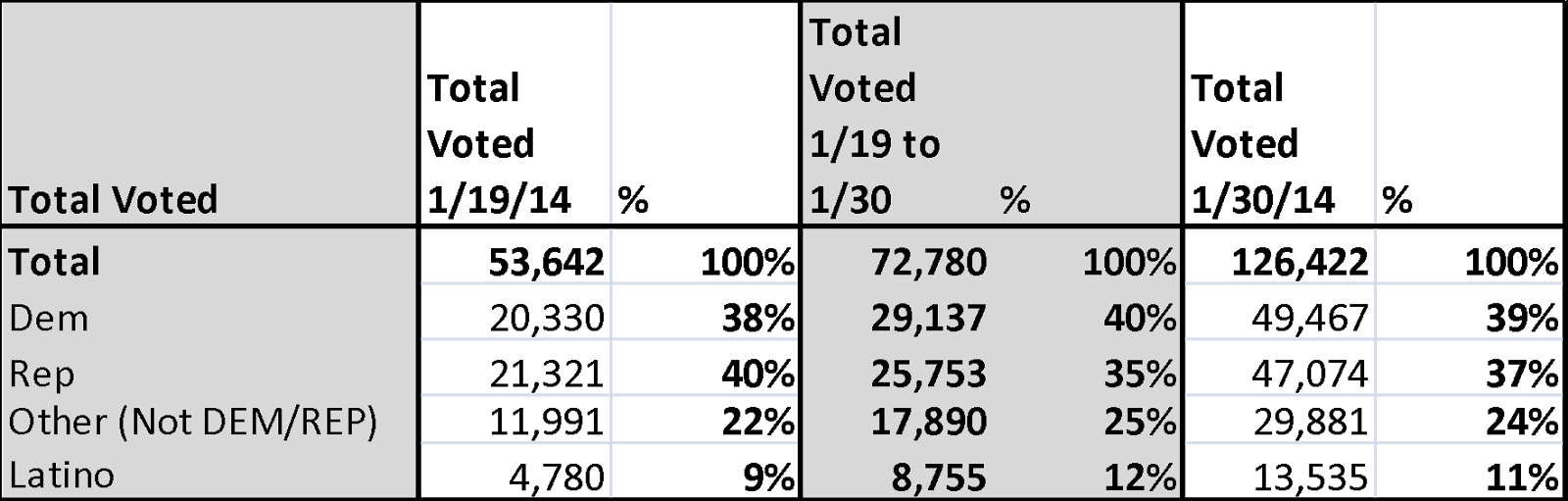
Table 1 shows an increase in the percentage of Democrats and Latinos and a drop off in the percentage of Republicans since early voting has started. The columns show early voters as of 1/19/14, between 1/19 and 1/30, and as of 1/30.  The rows show totals for party identification and Latino ethnicity.  Table 1 shows clear trend that favors Alvarez: between 1/19 and 1/30, the pool of early voters has grown more Democratic, more Latino, and less Republican.    
As shown in Table 2, the new entrants to the electorate (those who did not vote in the Primary on 11/19/13 and make up about 16% of the ballots so far) are more Latino and less Republican.  The Republican share of new voters is 7% less than its share of all early voters, the Democratic As shown in Table 2, the new entrants to the electorate (those who did not vote in the Primary on 11/19/13 and make up about 16% of the ballots so far) are more Latino and less Republican.  The Republican share of new voters is 7% less than its share of all early voters, the Democratic percentage is roughly the same, and the Latino percentage is 4 points higher.

The relevant facts presented in these tables are even more striking given that early voters tend to be less diverse and more republican than the electorate as a whole.     

Table 1: Total Voted


Table 2: Total New Voters (did not vote in primary on 11/19/13)