Saturday, March 1, 2014

Carl DeMaio: All Stunts, No Substance


Here we go again: Carl DeMaio is trying to highlight his so-called “reform agenda” by launching House of Cards-themed ads, but San Diego voters won’t buy it. As local media has already noted, DeMaio has long been known as “King of the Gimmick,” and comparing himself to pop culture’s most notorious political villain is just the latest example. This latest gimmick won’t help him rewrite his record of grandstanding, division and championing a radical agenda.

“We know that Carl DeMaio is desperate to avoid talking about his record, devastating Tea Party agenda, or any of the substance that real (not fictional) members of Congress have to deal with every day,” said Tyrone Gayle of the Democratic Congressional Campaign Committee. “So while Carl is playing with Photoshop, Scott Peters is working in Congress for middle-class San Diego families. It’s been said that the road to power is paved with hypocrisy and casualties. We don’t need more of either one from Carl.”

BACKGROUND:

DeMaio Called The Tea Party The “Conscience” of Government Reform And Assured He Would “Owe” Them. In 2011, speaking at a gathering of Tea Party members, DeMaio called the Tea Party the “conscience of the accountable government movement” and assured that he would “owe [them] and our collective movement everything.” [San Diego Tea Party event, 12/14/11, 13:45]

Union-Tribune: DeMaio is “Too Polarizing” And Would “Leave Behind a Divisive Legacy.” In 2012, the San Diego Union-Tribune wrote that DeMaio was “too polarizing” and that his defeat in the mayoral election “means that DeMaio will leave behind a divisive legacy.” [San Diego Union-Tribune, 11/08/12]


Thursday, February 20, 2014

STATEMENT OF ASSEMBLY MAJORITY LEADER TONI ATKINS ON DROUGHT RELIEF LEGISLATIVE PACKAGE


(Sacramento)  Today the Governor and legislative leaders announced a package of measures designed to respond immediately to the impact of the worst drought faced by California in its recorded history. Majority Leader Atkins issued the following statement in response to these proposals:

“This is an all-hands-on-deck moment for our state.  The emergency drought relief legislation will assist parched communities affected by severe water shortages by helping them to secure drinking water as well as providing assistance to those forced into unemployment by the drought. In addition, the legislation provides incentives for improved water conservation and delivery technologies.  This approach reaffirms the work done by the San Diego County Water Authority and local residents and businesses by emphasizing water conservation, funding improvements to our infrastructure that improve local water supply, water quality and storage capacity. Both urban and rural areas of our state will benefit from this legislation.

While the Legislature and the Governor prioritize immediate measures to alleviate the crisis, every Californian must also do their part by heeding the Governor’s call for a 20% reduction in their water use.  We must also continue with long-term plans to increase our storage and delivery capacity as well as pursuing alternative approaches to generating fresh water such as desalination.”

Key elements of the emergency drought relief package include:
  • Increased infrastructure investments by expediting funding for water supply and recycling, groundwater clean-up grants to disadvantaged communities suffering from drinking water contamination, and multi-benefit flood projects;
     
  • Enhanced enforcement authority for the State Water Resources Control Board to address water rights violations such as diverting or stealing water;
     
  • Help for those economically impacted by the drought, including food assistance, rent subsidies, and work force training;
     
  • Funding for new water efficiency and conservation activities, including California Conservation Corps water reduction and fire safety projects that will also provide employment opportunities for veterans and unemployed youth.


Chula Vista Firefighters Support 
Steve Padilla for City Council


CHULA VISTA - The Chula Vista Firefighters Association today announced its official endorsement of Steve Padilla for Chula Vista City Council in the June 2014 election.


"Steve Padilla has a proven record of working hand in hand with public safety officials and first responders to improve the safety and security of Chula Vista,” said John Hess, President of the Chula Vista Firefighters Association.  “We are proud to stand with Steve because we know he will work to fully fund public safety, give first responders the resources they need and work to improve response times in every community.   Chula Vista’s firefighters agree that Steve Padilla is the right choice to continue the work of many for safer, more secure neighborhoods.”


The endorsement from Chula Vista Firefighters comes on the heels of Padilla’s endorsement from Chula Vista Police Officers last week, making Padilla the unanimous choice of law enforcement and public safety in the campaign for City Council.  A former police officer, Padilla was well known during his pervious terms in office for taking a hands-on approach to public safety, participating in regular ride-alongs with rank and file officers and meeting regularly with the City’s Police and Fire Chiefs.


“I have tremendous respect for our firefighters who put their lives on the line for residents and work to make our City safe and secure,” said Steve Padilla.  “I believe we need to not only hold the line, but increase funding and resources for public safety so our first responders have the resources they need to protect and serve our communities.  It is an honor to have the support of Chula Vista’s bravest – our dedicated, courageous Firefighters.”


In recent weeks, the Padilla campaign has announced a growing list of major endorsements, including the Democratic Party and the Chula Vista Employees Association.  In addition, official campaign finance reports showed Padilla had raised five times more contributions for his campaign than his closest opponent.


Steve Padilla is a small business owner, environmental advocate and lifelong Chula Vistan.  He is a former police officer who previously served on the Chula Vista City Council, as Chula Vista Mayor and Port Commissioner.  He lives in the Otay Ranch section of Chula Vista.

MAJORITY LEADER ATKINS JOINS ADVOCATES TO ASSESS PREGNANT PRISONER SHACKLING ONE YEAR AFTER PROHIBITION


(Sacramento) Assembly Majority Leader Toni Atkins joined advocates for pregnant women who are incarcerated in releasing a report on compliance with Atkins’ legislation prohibiting the most dangerous forms of shackling.  The report states that while 21 of California’s 58 counties have fully complied with the law, the remaining counties have either not fully complied, not complied at all, or did not respond to inquiries.

“I am proud to be the author of legislation that protects both public safety and the health and welfare of pregnant prisoners and their newborns. I applaud the counties that have fully complied with this new law,” says Atkins.  “Having said that, in almost two-thirds of our state’s counties, pregnant prisoners are still being put at risk. It is my hope that in the very near future that will no longer be the case.”

AB 2530 became law in January 2013.  It prohibits the use of behind-the-back handcuffs, belly chains, and leg irons on pregnant prisoners.  These practices endanger the health of the woman and the outcome of her pregnancy.  A little more than one year later, Legal Services for Prisoners with Children (LSPC), one of the sponsors of Atkins’ 2012 legislation, contacted each county to determine the extent of compliance with the new law.

Thirty-two counties continue to have written policies that do not comply with the law, either because they permit the prohibited restraints, do not acknowledge that a woman’s doctor has authority to order the restraints removed, or do not inform prisoners of their rights.  Two counties have not complied at all with the new law and three counties failed to respond to inquiries. LSPC will continue to work with state and county officials to bring all facilities into compliance.

Shackling makes pregnant women unsteady on their feet.  They also make it extremely difficult to treat a woman in a medical emergency. Women in correctional facilities are more likely to experience miscarriage, pre-eclampsia, pre-term birth, and low birth weight than other pregnant women.

The Majority Leader and LSPC were also joined at the news conference by a physician representing the American College of Obstetricians and Gynecologists, District IX, which also sponsored AB 2530, and a representative of the California Coalition for Women Prisoners

California Assembly Majority Leader Toni Atkins was joined by Jesse Stout, Policy Director, Legal Services for Prisoners with Children, at a news conference to discuss compliance with Atkins’ legislation to prohibit shackling of pregnant prisoners.


Note:

###

Assemblywoman Lorena Gonzalez’s VOTE Act Proposes Postage-Paid Mail Ballots for Mail-Only Special Elections

AB 1873 Would Increase Participation, Save Taxpayer Money in Traditionally Low-Turnout Contests


SACRAMENTO – (Wednesday, February 19, 2014) – California State Assemblywoman Lorena Gonzalez (D-San Diego) introduced the VOTE Act today in an effort to boost voter participation and curb the taxpayer costs of special elections.

Assembly Bill 1873, known as the “Voting Ought To be Easy Act,” would allow California’s counties and cities to conduct special elections for legislative and municipal offices entirely by mail ballot, but would require them to provide full postage for all returned ballots if they choose to exercise the mail-only option.

Gonzalez said elections that don’t coincide with major statewide elections – like June primaries and November general elections – result in low voter participation and high costs for county election offices, which spend upwards of millions of dollars to set up polling locations and staff Election Day when local contests aren’t consolidated with a statewide election.

“Voters are more likely to participate in special elections if we give them several weeks to cast their ballots as opposed to a matter of hours on Election Day,” Gonzalez said. “By paying for the postage to return their completed ballot and providing voters an extended amount of time, the VOTE Act innovates our democracy in a way that will result in better access and participation – and that’s a good thing for California.”

Since the Presidential Election in November 2012, several special elections have taken place throughout California. Some legislative special elections failed to produce 10 percent participation rate. Even in the municipal elections that experienced higher turnout, voters who cast ballots at traditional polling place locations on Election Day made up just a fraction of all ballots cast in those contests as voters who mailed in a ballot represented the vast majority of those who participated at all.

“The special elections held in the last year show that a majority of voters choose to cast ballots in the four weeks leading up to Election Day by mail rather than at a polling place on Election Day itself. And for the large numbers who don’t cast ballots at all – whether it’s because they have a busy work schedule, family commitments or just plain forgot – it’s time California and their county elections office try cutting them some slack by giving them a larger window of time to exercise Democracy,” Gonzalez said.

Even by paying for the postage of every voter’s returned mail ballot, setting up Election Day drop-off locations for last minute voters, and allowing for in-person voting before Election Day, the VOTE Act is projected to save taxpayers money when special elections are needed. For example, the cost of every poll voter who cast a ballot in the 40th Senate District special election last March cost $221.43, according to the San Diego County Registrar of Voters. For every mail ballot counted in that race, the taxpayer cost was only $8.73.

For more information on the VOTE Act or to interview Assemblywoman Gonzalez, please contact Evan McLaughlin at (619) 850-2790 or (916) 319-2080.

Assemblywoman Lorena Gonzalez represents the 80th Assembly District, which includes Chula Vista, National City and the San Diego neighborhoods of City Heights, Barrio Logan, Paradise Hills, San Ysidro and Otay Mesa. For more information on Assemblywoman Gonzalez, visit http://asmdc.org/members/a80/.


Wednesday, February 12, 2014

Statement of California Democratic Party Chairman John Burton on the 
San Diego Special Election Results


Over the past several months, Democrats in San Diego and throughout California have been working day and night to elect a Democratic mayor of San Diego. Last night, Democrats’ efforts fell short but it was not for lack of effort or for lack of commitment on our coalition’s part.

David Alvarez ran a campaign all Democrats can be proud of and the vision he outlined for his city will serve as a progressive marker for candidates and officials who continue to work toward a better, more inclusive San Diego.

Throughout the campaign, our activists alone, led by the CDP’ Chicano-Latino Caucus, made more than 25,000 calls using our online phone bank. Democrats everywhere pitched in where they could and it was impressive to see San Diego Democrats, County Committees, Caucuses and Clubs from across the state working together in a great, unified effort to elect the first Latino mayor of San Diego since 1849.

I have no doubt that David Alvarez and the coalition that supported his campaign will remain a viable force not only in San Diego, but in California Democratic politics for some time to come.


Monday, February 10, 2014

Vote Alvarez for Mayor

This is it.

The special election for San Diego Mayor is tomorrow, Tuesday, February 11.

The campaign mail, phone calls, and television ads are coming to an end. Now all that matters is you.

Democrats need your help to elect DAVID ALVAREZ as Mayor of San Diego.

David is endorsed by President Obama and Governor Jerry Brown. He has a climate action plan, a cross-border economic plan to create middle-class jobs along with a commitment to protect the interests of neighborhoods over special interests.

He'll be there for us – and now we have to be there for him.

On Tuesday, February 11, please make sure your voice is heard. Vote for DAVID ALVAREZ for Mayor.

You can find your polling place at www.sddemocrats.org/polls.

If you have a vote-by-mail ballot, please drop it off at any polling place in the city on Election Day.

For assistance in voting, call (858) 277-3367.

Remember, vote DAVID ALVAREZ for Mayor.

Peace and friendship,

John Burton
Chairman
California Democratic Party


Saturday, February 8, 2014

President Barack Obama endorses David Alvarez


Today President Barack Obama endorsed David Alvarez to be the next Mayor of San Diego, applauding his focus on creating jobs and ensuring every child has access to a high-quality education


President Obama said, “As a native San Diegan, David Alvarez has been a fierce advocate for his city, and on the Council, has led efforts to build a strong middle class, put neighborhoods first and expand opportunities for kids in and out of school.  Today, with the city’s economy and neighborhoods poised to make progress there is no question that David is the right choice to be San Diego’s next mayor and I am excited to support him.

“It is truly an honor to receive President Obama’s endorsement," said Councilmember David Alvarez. "In my years of public service, I have championed many of the same priorities that the President addressed at the State of the Union. I look forward to working with him to achieve our shared agenda and priorities. Together, we can make San Diego a city that expands opportunity for all.”

###


ATKINS BILL WILL ENCOURAGE MORE TO SEEK DOMESTIC VIOLENCE SERVICES


(San Diego) Assembly Majority Leader Toni Atkins today introduced legislation that is intended to encourage survivors of domestic violence to seek assistance by ensuring the confidentiality of all personal information they may reveal to staff at domestic violence assistance centers.

“Sometimes, it is critical that victims of abuse share personal, private information with the people who are trying to help them.  They may have other problems in their lives that bear on the abuse and it is important for service providers to have a full picture,” says Atkins. “The most important first step in addressing abuse is to get the victim, and any children involved, into a safe and healthy situation.  If a victim fears that they themselves might get in trouble by trying to escape an abusive environment, they are not likely to seek help.”

Family Justice Centers are integrated one-stop multi-agency resources for victims of domestic violence and sexual assault.  They improve services to victims by preventing them from having to travel to multiple service agencies and tell their traumatic story to several different service providers.  Typically, Family Justice Centers include law enforcement.

AB 1623 is based upon a recent study of the Family Justice Center model in California that was called for by 2011 legislation authored by San Diego Senator Christine Kehoe.  The study, conducted by Dr. Carrie Petrucci of EMT Associates, Inc., identified best practices and also made recommendations for reducing barriers to service. One of the recommendations was to establish a bright line of separation between law enforcement and other services so that confidential information provided by victims would be protected.  In some cases, there may have been some criminal activity in the home or possibly a substance abuse issue.  Many survivors are worried about losing their children. Others may be undocumented and fear their families will be torn apart if they seek help. Protecting victims’ privacy will encourage them to come forward and seek help.  AB 1623 establishes the confidentiality requirement for all multi-agency domestic violence centers in the state where law enforcement is a partner agency.

"This legislation will set high standards for every Family Justice Center in California and provide confidentiality protections to victims and their children coming forward for help in the midst of life threatening domestic violence,” says Casey Gwinn, co-founder of the first Family Justice Center in the country.  “Many victims want to come one place for all their services so they don’t have to go from agency to agency, telling their story over and over again.  Too often when victims have to go many places, they give up and go back to their abusers."

“The San Diego Family Justice Center is a true partnership that provides services to combat domestic violence and has proven to be a model of success,” says San Diego Police Chief William Lansdowne.  “I am proud to support this new bill which defines the family justice centers and ensures the life-saving collaborative work between all involved will continue.”


AB 1623 is expected to be scheduled for a legislative hearing in an Assembly policy committee some time next month.


Friday, February 7, 2014

Fourth Time Still Might Not Be The Charm

Sunday night/Monday morning a candidate you can usually expect to see on a ballot in most elections seems might not be ready for another ballot so soon.
After a night of alcohol, Dwayne Crenshaw was caught sleeping behind his parked car's steering wheel by law enforcement.  When he was awaken by them, Crenshaw was allowed by police to call for a car service to be picked up.  After he and the police left, then it seems Crenshaw doubles back attempting to drive his car.  Oh, but not so fast Crenshaw.  Law enforcement saw his car, pulled him over, and took him into custody.   They tested him showing a result above the legal 0.08 alcohol level.  No charges have yet been leveled, but awaiting a decision from our esteemed city attorney.   

Interesting, Crenshaw is working to help his college buddy San Diego City Councilmember Kevin Faulconer for mayor, as we have seen and read in local papers and Facebook postings.  Many question whether Faulconer will distance himself from Crenshaw.   At this point Crenshaw is still featured on Faulconer's campaign social media.  In addition, Crenshaw was rumored to be seeking to challenge San Diego City Councilmember Myrtle Cole in her re-election this June.  Crenshaw had been a good solider for many of the Republican establishment in Faulconer's campaign and hoped they would again invest in his next election endeavor. It was suspected his lawsuit against Cole was part of his plan in challenging her and would be used in his campaign materials to attack her.
Now it seems with this arrest, Crenshaw and his new Republican allies will need to re-think his election bid and they will need to look for another pawn of the Lincoln Club and the downtown establishment.  We can still expect Crenshaw to seek an elected office in the not so near future.
To read more about the arrest click here: http://m.utsandiego.com/news/2014/feb/07/dwayne-crenshaw-dui-arrest/

Thursday, February 6, 2014

Response to the National University System Institute for Policy Research (NUSIPR) Flawed Mayor's Race Study


Guest Post by Henry Kim Assistant Professor, Political Science University of Arizona
The National University System Institute for Policy Research (NUSIPR) has issued a recent policy brief regarding the San Diego Mayoral election that is largely grounded on potentially fallacious interpretation of pertinent facts.  The only non-trivial claim being made is that “Faulconer leads in early voting,” as the title of the report indicates.  To support this conclusion, NUSIPR draws on two facts: 1) Republican absentee ballots are being returned at a higher rate than Democratic ballots, and 2) turnout in voter precincts that favored Faulconer is higher than in pro-Alvarez precincts.
Difference in the rates of turnout among different parties’ absentee voters provides no useful information about which candidate is leading in early voting, without reference to the difference in their actual numbers. For example, Reform Party absentee voters currently lead both democrats and republicans in early voting with a whopping 56% of ballots returned to date, but no one would seriously argue that the Reform Party’s 266 ballots are “leading in early voting.”  As the Table 3 of the NUSIPR report indicates, the raw number of Democratic absentee votes is substantially larger than the Republican:  despite the lower rate of turnout, Democrats currently lead Republicans by about 3,000 votes in ballots submitted.
By concluding that Faulconer is leading early voting because turnout in voter precincts that favored Faulconer in November is higher than those precincts that favored Alvarez, NUSIPR is ignoring the substantial differences in the electoral landscape between the first and second rounds of the election.  In the first round of the election, Democratic votes were split among Alvarez and two other major candidates.  With only two candidates of different party affiliations remaining, it is improbable that the second round votes will simply replicate the patterns seen in the first.  Furthermore, the electorate of the second round is likely to include a large number of new voters who did not participate in the first.  Over 16% of the ballots cast thus far are from voters who DID NOT vote in the primary.  Their vote choices cannot be reliably predicted simply based on the patterns seen in the first round.  Point 2 thus represents an excellent example of an “ecological fallacy”: NUSIPR infers that the individual general election absentee voters will behave the same as the group (primary polling locations) to which they belong.       
So who is really leading early voting? Based on the relevant facts, the most likely answer is Alvarez. Let us take a closer look at the data.
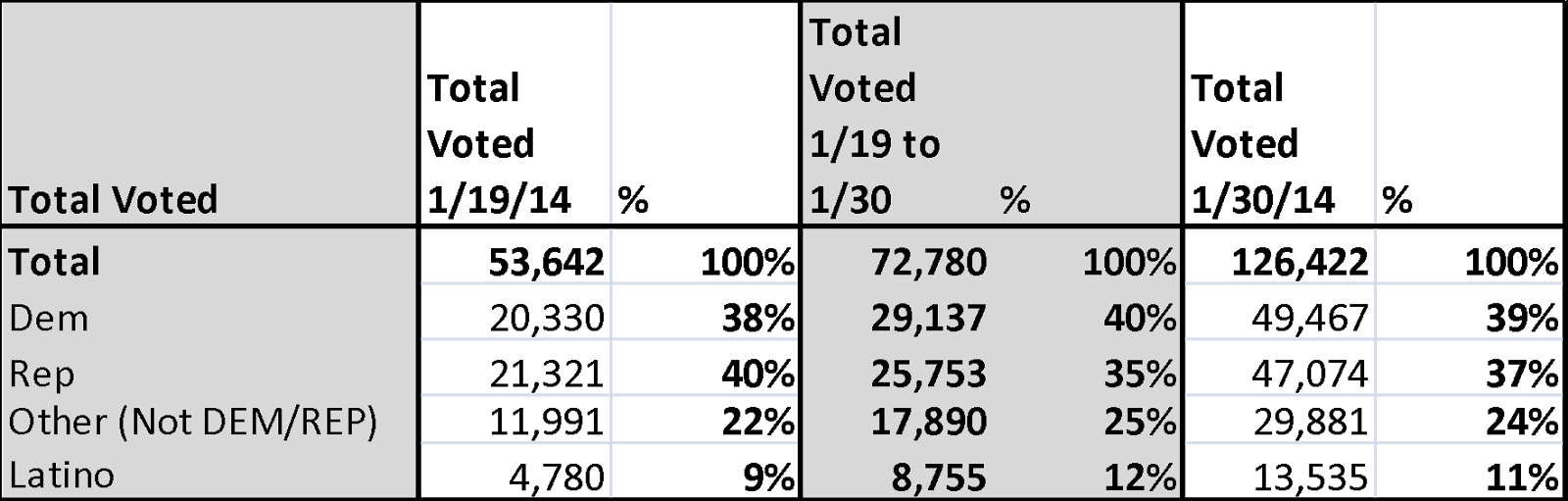
Table 1 shows an increase in the percentage of Democrats and Latinos and a drop off in the percentage of Republicans since early voting has started. The columns show early voters as of 1/19/14, between 1/19 and 1/30, and as of 1/30.  The rows show totals for party identification and Latino ethnicity.  Table 1 shows clear trend that favors Alvarez: between 1/19 and 1/30, the pool of early voters has grown more Democratic, more Latino, and less Republican.    
As shown in Table 2, the new entrants to the electorate (those who did not vote in the Primary on 11/19/13 and make up about 16% of the ballots so far) are more Latino and less Republican.  The Republican share of new voters is 7% less than its share of all early voters, the Democratic As shown in Table 2, the new entrants to the electorate (those who did not vote in the Primary on 11/19/13 and make up about 16% of the ballots so far) are more Latino and less Republican.  The Republican share of new voters is 7% less than its share of all early voters, the Democratic percentage is roughly the same, and the Latino percentage is 4 points higher.

The relevant facts presented in these tables are even more striking given that early voters tend to be less diverse and more republican than the electorate as a whole.     

Table 1: Total Voted


Table 2: Total New Voters (did not vote in primary on 11/19/13)

Friday, January 31, 2014


MAJORITY LEADER TONI ATKINS BILL WILL PROMOTE PROPER GENDER IDENTIFICATION ON TRANSGENDER DEATH CERTIFICATES


(Sacramento)  Assembly Majority Leader Toni Atkins has introduced legislation that will ensure that the wishes of transgender people with respect to their gender identity are respected in the process of completing official death certificates.  AB 1577 requires that death certificates reflect the gender on other official documents, such as a driver’s license or birth certificate, if the person had the document formally changed following a gender transition.  If no such documents exist, legal next-of-kin will then be consulted by coroners and funeral home directors, who are responsible for completing these documents.

“A person should rest in peace after death as the same person they were during life,” says Atkins. “This bill is designed to ensure that the wishes of a transgender person regarding their gender identity are respected after they have passed on.”

Transitioning from one gender to the other can be a long and complicated process for a transgender person and it is not uncommon for a person to present externally as their preferred gender identity while retaining the private physical characteristics of the gender assigned to them at birth.  This can lead to confusion at death if authorities have only the sometimes conflicting physical attributes to rely on.  If a transgender person has taken steps to change their official documents, such as driver’s license or birth certificate,  that is a reliable source of a person’s correct gender identity.  AB 1577 will also reduce conflict among family and friends that sometimes occurs in these situations and will provide funeral directors and coroners with clear guidance on how to avoid legal repercussions for their decisions about the gender of a person who has passed on.

AB 1577 was inspired in part by the case of Christopher Lee of Alameda County, a transgender person and community activist who died in December of 2012.  Despite his having transitioned from female to male, Lee retained much of his female anatomy.  After a dispute among his family and friends, the coroner ultimately identified Lee as female on his birth certificate, despite the fact that Lee lived as a man.

AB 1577 is sponsored by Equality California and the Transgender Law Center.  The bill will now be assigned to a policy committee for review, with a first hearing anticipated some time in March.


# # #

Saturday, January 25, 2014

Free Cash for College workshops run through March 1 at area high schools


High school seniors, local elected officials and San Diego School District representatives gathered today with one message for students, “There is money for college and there are people to help you get it.”

In a unified effort to encourage seniors to find “cash for college” local educators and elected officials announced their efforts to promote 13 upcoming financial aid workshops in San Diego County schools with a special “promotional” incentive – a $1,000 Cash for College scholarship offered to one student at each workshop.

The events which run through March 1 help students complete the federal and state forms to apply for college aid assistance.

“California is facing a water drought this year, but we’re also facing another kind of drought – a drought of highly skilled workers and adults with baccalaureate degrees, post graduate certificates and two-year degrees,” said State Senator Marty Block (SD-39).

He added that it is critical that high school students not only meet the educational requirements for admission and success in college, but also have the financial support they need to further their education and become part of the skilled workforce critical to California’s economy.

“Only 35 percent of California’s adults now have a four-year degree or higher, but by 2025, 41 percent of the state’s jobs will require a bachelor’s degree or higher,” Block said. “One study estimates that we will need an additional 60,000 baccalaureate degrees a year, on top of the 150,000 baccalaureates now produced by California’s public and private colleges.”

In addition to Block, Assemblywoman Lorena Gonzalez (AD-80), U.S. Representative Scott Peters (CD-52) and San Diego Unified School District Board Trustee Richard Barrera participated in the news conference and said they would assist in promoting the workshops.

Students and parents may visit http://www.calgrants.org/applications/workshops.cfm?navId=25   to find a “Cash for College” workshop location in their neighborhood and to learn what students must bring with them.
###

Proudly representing the cities and communities of San Diego, Del Mar, Solana Beach, and Coronado


Thursday, January 23, 2014

WeAllCount Homeless Census to take place in San Diego County on Jan. 24


SAN DIEGO – Jan. 22, 2014 – An estimated 1,300 volunteers will participate in WeAllCount on Friday, Jan. 24 from 4:00 a.m. to 7:00 a.m.

Sponsored by the U.S Department of Veterans Affairs (VA) and County of San Diego, the 2014 count of homeless persons in San Diego County will be directed by the Regional Task Force on the Homeless.

“We have an incredibly large task ahead of us and that is to accurately count homeless individuals including veterans, women and children in San Diego County,” said Dolores Diaz, Regional Task Force on the Homeless Executive Director. “Some very special volunteers and community leaders will be graciously giving their time to help us count the homeless.”

That list of names includes officials from the VA, members from the Board of Supervisors, Assemblymember Toni Atkins, San Diego Interim Mayor Todd Gloria and San Diego City Councilmembers David Alvarez, Kevin Faulconer, Mark Kersey and Scott Sherman among many others who are scheduled to help with the count throughout the county.

Mandated by the U.S. Department of Housing and Urban Development (HUD), WeAllCount is the San Diego region’s annual Point-In-Time-Count (PITC) census conducted to identify the number of homeless individuals including sheltered and unsheltered, their locations and detailed demographic information.

This data enables the San Diego region to better understand the scope, impact and potential solutions to homelessness. It also enables the community to qualify for funding that is critical to addressing the issue and enable people to leave the street.

The aforementioned list of volunteers are scheduled to be deployed from Golden Hall in downtown San Diego, one of many deployment centers set up throughout the county, and will be available for media interviews upon request.

About the Regional Task Force on the Homeless
The Regional Task Force on the Homeless (RTFH) is an independent 501(c)(3) nonprofit corporation. It supports, empowers and collaborates with San Diego County’s homeless service providers on a myriad of issues. Working together, the organization’s purpose is to help prevent, alleviate, and work towards ending homelessness.

RTFH is the data center and technical resource for information on homelessness throughout San Diego County. It administers the region's Homeless Management Information System (HMIS), used by service providers who manage hundreds of distinct programs. Data gathered enables RTFH to provide analysis of demographics, trends, and more. Services include training, help desk, and critical data reports to service providers, cities, the County of San Diego, elected officials, the Department of Housing and Urban Development (HUD), and U.S. Congress.

Block: ‘We face more than one kind of drought’


“The Governor began his speech by celebrating the creation of one million new jobs in California. Unfortunately a skills gap exists that keeps many of these jobs vacant.

“Gov. Brown urged prudence warning of economic uncertainty caused by the drought – but we face more than one kind of drought. Like crops in California’s central valley, the supply of highly sought after, highly skilled workers has dried up in many parts of the state.

“We must rain resources on workforce development and community college programs that could end the drought of highly skilled workers threatening California’s future. Such rain is necessary for the growth of our economy.”


STATEMENT OF ASSEMBLY MAJORITY LEADER TONI ATKINS ON GOVERNOR BROWN’S STATE OF THE STATE ADDRESS


(Sacramento) The Governor has laid out a forward looking but strategic vision for our state’s future.  Achieving our state’s comeback, as the Governor calls it, is due to disciplined work by the Governor and the Legislature as well as the support of the voters of California for the temporary taxes enacted through proposition 30.  Our hard work and faith in the future has paid off.

Democrats in the Assembly agree  that our state is on the rebound, but that it is also important for us to be cautious and conservative as we look at how best to use state resources now that the crisis caused by the great recession is behind us. The most important principles we should apply as we go forward are maintaining stability and investing in opportunity.

I am particularly pleased to see that Governor Brown has embraced the idea of putting the creation of a rainy day fund before the voters this November.  We must not operate the state based upon a boom and bust mentality. The rainy day fund will insulate our state from the ups and downs of the economic cycle so that we can maintain a steady level of funding for programs, providing predictability and reliability for businesses and individuals, but also preventing over-spending in the good years by requiring that money be put into our savings account.

Another area of agreement is that we should make paying off the debt that we racked up during the great recession a priority. Number one on that list, as the Governor has suggested, should be restoring funds to our public schools that were deferred during the economic downturn.  These deferrals represented cuts to the operating budgets of schools that had a direct impact on students in the classroom.

I also agree that investing in education is the best use of our resources because the payback comes in terms of prosperity and quality of life for every Californian. Additional funding for K-12 and public colleges and universities and a new formula to ensure extra resources for school districts with the highest number of struggling students will help ensure that each student has access to a high quality, affordable education to prepare them to be adults and workers in a global marketplace.

Water has been a scarce resource that California has struggled with since before we were a state.  Even in good years, we have to balance the needs of agriculture, residents, and natural areas and wildlife.  In a drought year such as the one we are currently experiencing, we all must cooperate and sacrifice to ensure that basic needs are met.  I am committed to working with my colleagues in the Legislature to develop new approaches to water that ensures an adequate supply, even after we get past this year’s drought.

Our water shortage due to a lack of rain is just one of the many important reasons we must continue to seriously address the impact of climate change.  Air quality, sea level rise, threats to the cleanliness of our water, wildfires, and a host of other threats to our way of life are also a result of climate change.  I will be working with my legislative colleagues to continue California’s leadership on climate change.

Today, the Governor urged us to build for the future, not steal from it.  I look forward to working with him and my colleagues in the Legislature to produce another on-time balanced state budget and to adopt legislative proposals that make that goal a reality.

TONI ATKINS CHOSEN AS ASSEMBLY SPEAKER


(Sacramento) Assembly Majority Leader Toni Atkins of San Diego has been chosen by her Assembly Democratic colleagues to succeed Assembly Speaker John A. Pérez as the next Speaker of the Assembly.

“I am humbled, grateful, and ready to get to work,” says Atkins.  “From the drought we are experiencing to ensuring a healthy business climate and a world class educational system, California is facing important issues in the near future.  I look forward to leading the State Assembly in working with the Senate and the Governor to meet our challenges and to move our great state forward.  I thank my Assembly colleagues for their confidence and support.

I also am very grateful to Speaker Pérez for his support and mentorship and I look forward to working with him on a smooth transition.”

With her selection as Speaker, Atkins becomes only the second Democratic woman and second member of the LGBT community to hold the post.  As Majority Leader, she is already responsible for the day to day operation of the Assembly Floor and has served as a member of Speaker Perez's leadership team.

Atkins represents a coastal San Diego district and was elected to the Assembly in 2010 following eight years on the San Diego City Council.


Saturday, January 18, 2014

Foul me once, shame on you, fool me twice shame on me. San Diego Police Officers Association, shame on you!


I find it interesting that on one hand San Diego City Councilmember Kevin Faulconer and his alliance of the radical right-downtown establishment-big business groups are touting his endorsement from the San Diego Police Officers Association, then hitting San Diego City Councilmember David Alvarez for his support from unions.  What the heck do you mean?

Well, you have the mixed-up world here in San Diego.  The San Diego Police Officers Association is a UNION!  They may not have the word UNION in their title, but they are a U-N-I-O-N.  In fact, they are a San Diego City U-N-I-O-N, which their members are part of the PENSION, which Councilmember Faulconer and his alliance of the radical right-downtown establishment-big business group blame for the city’s demise.  In fact, his backers would like to eliminate the polices pension, like they did for all the other unions at the city, just ask the UT Editorial Board.  While it is okay to denounce Councilmember Alvarez for getting support from unions it would not be right to do the same of Councilmember Faulconer, right?  There is a saying, “If you point a finger at someone else, three of your fingers are pointing back at you.” Try it.  They are just a bunch of hypocrites, but we knew that one.

Though, the bigger scratching of my head was over the San Diego Police Officers Association for supporting Councilmember Faulconer.  Some dogs just don’t learn it seems.  It is important to point out that Councilmember Faulconer told this union and the San Diego Firefighters in his first win for San Diego City Council to get their endorsement and money he would support them as councilmember.  How did that work out?  Well the firefighters are now supporting Councilmember Alvarez.  You see they both got screwed by Councilmember Faulconer.  He voted to cut their budgets, freeze their pay, not replace their equipment, actually made them pay more for benefits thus reduced their take home pay, made it harder for them to recruit new officers and he pals around with those same Wisconsin anti-labor alliance of the radical right-downtown establishment-big business group.  Now Councilmember Faulconer has a plan, just like former San Diego City Councilmember Carl DeMaio had a plan.  Just don’t look at the details, because you won’t really like it.  Details, details.  Also, this alliance of the radical right-downtown establishment-big business groups supports eliminating the police the right to have their union, which is spending their union money for Councilmember Faulconer’s election, which the Councilmember and his alliance of the radical right-downtown establishment-big business groups are now touting and using for his campaign material.  Crazy isn't it?

Let’s put it this way:  What ten year old kid would want to play after school with the another kid who took food off their dinner table, abuses you and tells it is becaus they love you, does not like the way you live your life and tells the neighbors they think your family should not have the right to exist?  I don’t think you would find one kid that gullible, but the police union just signed up for round two!  There is another saying, “actions are louder than words,” and for the past 7 years Councilmember Faulconer has been talking out of one side of his body about the police union, while signing petitions, writing op-eds and voting to hurt the same San Diego Police Officers Association

Friday, January 17, 2014

Interim Mayor Todd Gloria Endorses David Alvarez for Mayor Citing Readiness to Lead, Shared Values

Backing comes after ambitious State of City agenda roll out – Gloria picks Alvarez as best to carry forward


SAN DIEGO, January 17, 2014 – Today San Diego Interim Mayor Todd Gloria announced an enthusiastic endorsement of City Councilmember David Alvarez as San Diego’s next Mayor.


I am pleased to endorse David Alvarez to be our next mayor,” said Interim Mayor Gloria.

Gloria cited Alvarez’s experience on the City Council fighting for a strong economy and healthy neighborhoods for all of San Diego as the top reasons Alvarez is the best choice to lead as Mayor.

Gloria also highlighted his partnerships with Alvarez.

David Alvarez has been a valuable member of our City Council,” said Interim Mayor Gloria. “He and I have worked together to increase funding for affordable housing, update the Barrio Logan community plan, and passed the 2014 budget increasing vital city services.

Alvarez’s opponent opposed all three of these in the interests of his corporate downtown campaign funders.

With less than a month until San Diego’s Special Mayoral Election on February 11, Gloria’s State of the City Address Wednesday night included an ambitious agenda that he’s confident Alvarez will carry forward.

This week, I put forward a progressive vision for San Diego to be a great city.  It includes ending homelessness, increasing the minimum wage, aggressively funding infrastructure, and implementing a strong Climate Action Plan,” said Interim Mayor Gloria. “David Alvarez is the candidate in this race who shares my vision and who we can count on to make San Diego great.

Alvarez stated he’ll work hand in hand with Gloria to ensure these initiatives are successful and congratulated him on his hard work to pull San Diego out of crisis mode and put the City back on course.

I’m proud to have Interim Mayor Gloria’s support,” said Councilmember Alvarez. “I’m also excited about the path to prominence he laid out for San Diego and look forward to working with him on our shared vision.

Gloria’s endorsement was added to a list of dozens of respected elected, community, and business leaders committed to helping elect Alvarez as “a Mayor for All of Us.”

Gloria is travelling until next week, but was eager to release his endorsement. The two will make a joint appearance soon.

Thursday, January 16, 2014

Carl DeMaio Continues to Play Follow the Leader on Scott Peters’ Reform Proposals


Once again, Carl DeMaio is trying to claim credit for someone else’s ideas; this time, DeMaio is promoting an ad about “No Budget, No Pay,” an idea that Scott Peters championed and helped to pass. DeMaio has made it a habit to take credit for others’ work, and former San Diego Mayor Jerry Sanders has pointed out this fact in the past.

“Carl DeMaio knows that his record of grandstanding, division, and a radical agenda won’t fly with San Diego voters, so once again he is trying to take credit for the good work others are doing,” said Matt Inzeo of the Democratic Congressional Campaign Committee. “Carl DeMaio needs to quit his dishonest tactics if he wants to win voters’ trust.”


BACKGROUND:

January 2014: DeMaio Promoted “No Budget, No Pay” In A Web Ad.
In January 2014, DeMaio promoted “No Budget, No Pay” in an online advertisement. The ad stated the following: “’No Budget, No Pay.’ Permanently take away Congress’ pay for every day the budget is late.” [Fix Congress First YouTube ad, 1/15/14]
 
…But Peters Called for “No Budget, No Pay” Back In October 2012. In 2012
, then-candidate Scott Peters launched a 30-second television ad calling for “No Budget, No Pay” as a way to hold representatives accountable for doing their jobs and passing a federal budget. In the ad, Peters said, “It’s time Congress worked for us. I say – no budget, no pay.  If Congress doesn’t do their job and balance the budget – they don’t get a paycheck.” [Scott Peters for Congress press release, 10/20/12]

…And Voted for “No Budget, No Pay” In January 2013
. In 2013, Rep. Scott Peters voted for HR 325, which adopted a version of “No Budget, No Pay,” an initiative Peters declared his support for prior to being elected to Congress. In addition Peters co-sponsored HR 310, the No Budget, No Pay Act, which would stop Congressional pay if Congress fails to pass a budget on time. [HR 325, Vote # 30, 1/23/13; Rep. Scott Peters press release, 1/23/13]
 
Peters Co-Sponsored the Stop Pay for Members Act
.
In 2013, Rep. Peters co-sponsored the Stop Pay for Members Act, which would ensure that Members of Congress would not get paid if the U.S. defaulted on its debt. [HR 1884, Cosponsors, 9/27/13]